01
The eelgrass beds
Zostera marina — eelgrass — carpets 84,000 acres of Izembek Lagoon, forming one of the largest continuous beds on Earth. This underwater meadow fuels the entire refuge food web, feeding brant, ducks, herring, and salmon.
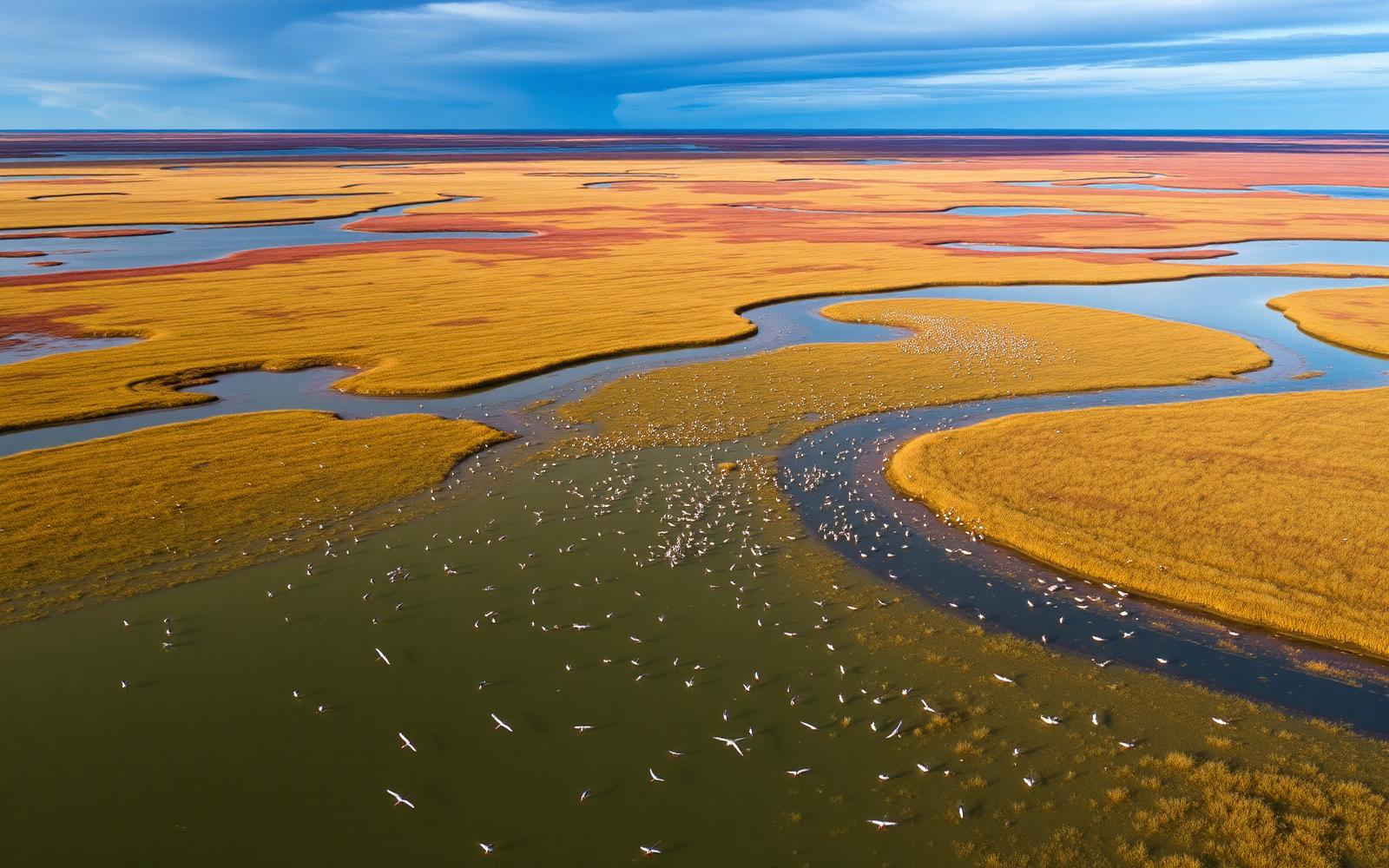
417,000 acres of tundra, lagoon, and volcano — and one of the most important stopover sites for migratory birds on the planet.
Established in 1960, Izembek National Wildlife Refuge is Alaska's smallest but arguably most globally significant refuge. Its centerpiece is Izembek Lagoon, whose eelgrass beds are among the largest in the world and support nearly the entire global population of Pacific black brant during fall migration. Add in emperor geese, tundra swans, Steller's eiders, brown bears, and caribou, and you have one of the great wildlife landscapes of North America.
Zostera marina — eelgrass — carpets 84,000 acres of Izembek Lagoon, forming one of the largest continuous beds on Earth. This underwater meadow fuels the entire refuge food web, feeding brant, ducks, herring, and salmon.
Each September and October, roughly 98% of the global Pacific black brant population — 150,000 to 315,000+ birds — stages at Izembek to fatten on eelgrass before flying nonstop 3,000 miles to Baja California. It is one of the most concentrated waterfowl spectacles on the continent.
The refuge offers world-class viewing of brown bears, caribou, foxes, sea otters, and migratory birds. Blinds, boardwalks, and driving loops make much of it accessible. Fall migration and spring bear emergence are peak seasons for photography.
A limited road network connects Cold Bay to the refuge boundary, with foot access to Grant Point, Frosty Peak trails, and the shoreline. Terrain is open tundra with soft ground — waterproof boots and layered clothing are essential.
Designated a Wetland of International Importance under the Ramsar Convention in 1986, Izembek has been at the center of ongoing debates over a proposed road connecting King Cove to Cold Bay. Today it remains one of the wildest and most intact refuges in the U.S. system.